
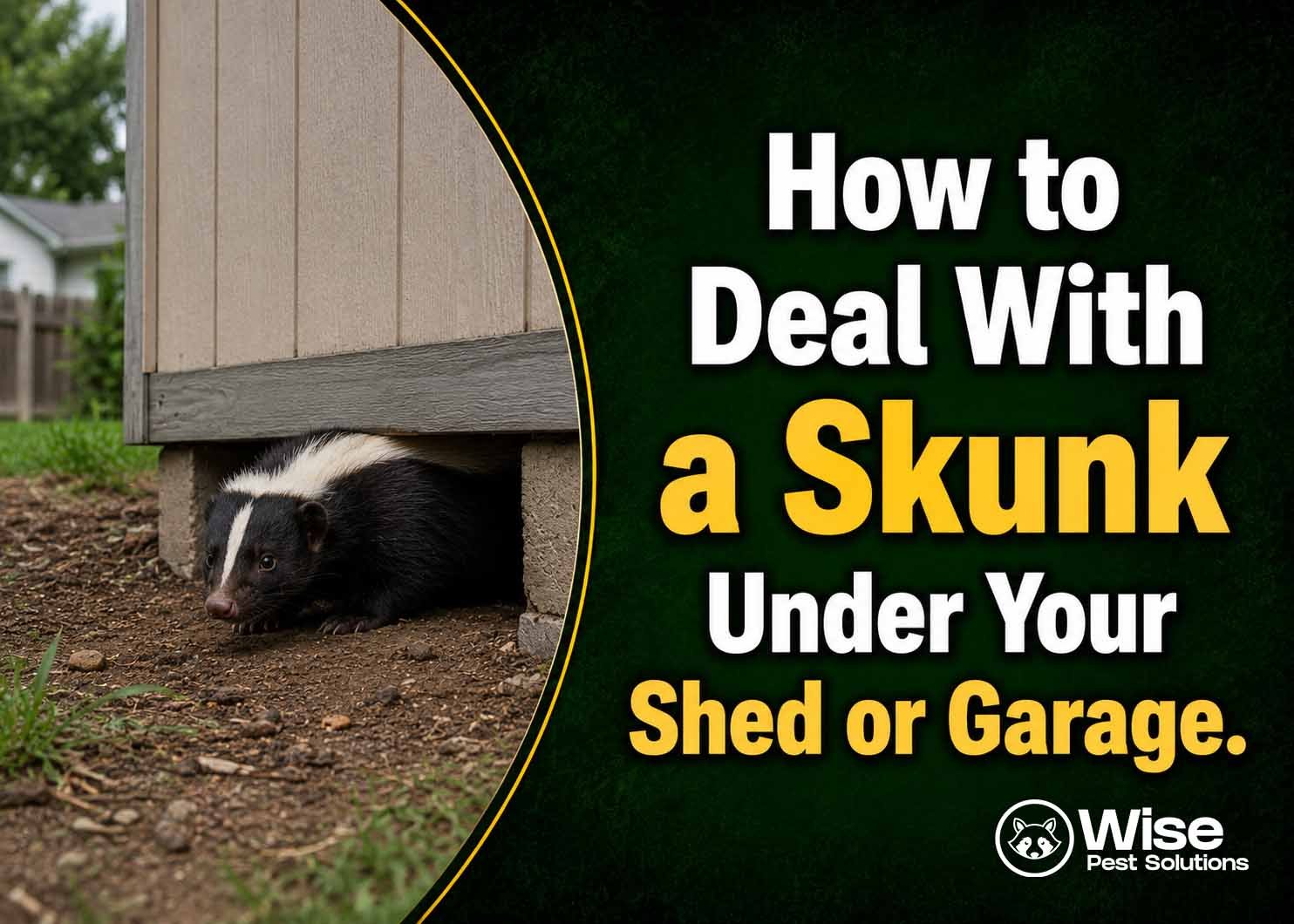
You step outside for the morning paper and the smell hits before your foot touches the driveway. Not garbage day, not a neighbour’s fire pit. That thick, sour odour usually means something has moved in close, and there’s a good chance it’s living under your shed or garage.
Skunks don’t pick fights. They pick real estate. A shed with a two-inch gap at the base, or a garage with loose siding near the foundation, looks like a five-star den to a skunk hunting for a dry, dark, quiet spot. Late winter into spring is when this search peaks, since skunks are looking for denning sites right before mating season, and again in fall before the cold sets in. Once one settles under a structure, the smell, the digging, and the risk of a spray only build the longer it stays.
This guide walks through how to spot the problem early, what makes a skunk under garage spaces different from one under the actual house, and why calling in skunk removal services beats handling it yourself.
TL;DR:
- A skunk under shed or garage situation is drawn in by an open gap, food nearby, and quiet shelter.
- Watch for sharp odour, small digging holes, and disturbed soil along the structure’s base.
- Never seal the opening yourself. The skunk may still be inside.
- Skunk removal services confirm the animal has left before closing the entry point for good.
Why Skunks Choose a Shed or Garage in the First Place
A skunk doesn’t need much. Darkness, a dry floor, and protection from wind and larger predators are enough to convince it to stay. Sheds and garages check every box, especially older ones with settled foundations or gaps where the siding meets the ground.
Food plays a role too. Grubs under a nearby lawn, an unsecured garbage bin, or pet food left outside overnight all pull skunks closer to a building. Once they’re circling a yard at night, the shed becomes the obvious next stop.
Garages carry an extra risk. Vehicles, stored boxes, and clutter near the base give a skunk more cover and more places to den undisturbed. A skunk under garage clutter can go unnoticed for weeks if nobody checks that corner regularly.
Signs You Have a Skunk Under Your Shed or Garage
The smell is usually the first clue, but it’s not the only one. A skunk marking territory, even without spraying, leaves a faint musky scent right at the den entrance.
Look for these on your next walk around the property:
- A persistent, sharp odour near one specific corner of the shed or garage
- Small, cone-shaped holes in the lawn nearby, from digging for grubs
- Loose soil or a fresh dirt pile at the base of the structure
- Scratching or shuffling sounds at night, usually just after dusk
- A dog or cat that keeps fixating on the same spot along the wall
One or two of these on their own might not mean much. Several together, especially paired with the smell, usually point to an active skunk under shed den.
Skunk Under a Shed vs. Skunk Under a House
A skunk under shed structures and a skunk under house situation create similar problems, but the stakes shift depending on where it happens.
Odour risk: Shed or garage keeps it mostly outdoors. Under the house, it can seep into basements and living spaces.
Access points: Sheds have gaps at the base or loose panels. Houses have foundation vents, porch overhangs, and crawl spaces.
Urgency: A shed situation is moderate, monitor and act. A house situation is higher priority, since odour and insulation damage move indoors fast.
Structural risk: Sheds see minor digging and soil damage. Houses risk wiring, insulation, and vapour barrier damage.
A skunk under a shed is mostly a nuisance until it’s ignored too long. A skunk under house problem brings the smell indoors and puts insulation and crawl space materials at risk. Either way, the fix starts the same: confirm the den, then remove it properly.
What Not to Do When You Find a Skunk Under Your Garage
The instinct to seal the hole right away makes sense, but it’s the fastest way to make things worse. A trapped skunk inside a closed space digs harder, sprays out of panic, or dies inside, which creates a far bigger odour problem than the one you started with.
Don’t try to flush it out with water, smoke, or noise either. A cornered skunk sprays when it feels threatened, not when it feels annoyed. Getting close enough to scare it off usually means getting close enough to get sprayed.
Mothballs and home remedies rarely work long term. They might push the skunk a few feet over, but they don’t fix the actual gap letting it in.
How Professional Skunk Removal Services Handle It
A proper job starts with an inspection, not a trap. A technician checks the shed, garage, deck, and any nearby structure to find where the skunk is entering and how long it’s likely been there.
From there, the process follows a few clear steps:
- Confirm activity, checking tracks, digging, and odour patterns to understand how the skunk is using the space.
- Remove humanely, using low-stress methods that get the skunk out without provoking a spray.
- Check for young, since a den with kits needs a different timeline than an empty one.
- Seal the entry point, only after confirming the space is clear.
- Follow up, with a return visit to confirm no new activity has started.
This is the core of what real skunk removal services do differently from a DIY attempt. Sealing before confirming the den is empty is the single biggest mistake homeowners make, and it’s the one step a trained team never skips.
What to Look for Before Hiring Someone
Not every wildlife call handles skunks the same way. A few things worth checking before booking anyone:
- Experience with skunks specifically, not just general pest control
- A clear inspection step before any removal or sealing happens
- Humane methods that don’t rely on poison or harsh chemicals
- Prevention advice included, not just a one-time removal
- Local experience with the shelter types common in your area, whether that’s older sheds, attached garages, or raised decks
A company offering broader wildlife removal alongside skunk-specific service usually has the experience to handle whatever else the same gap might be attracting, since raccoons and opossums like the same tight spaces skunks do.
What Skunk Removal Actually Costs
Pricing depends on how the skunk got in, how long it’s been there, and whether kits are involved. A straightforward job with one entry point costs less than one involving multiple gaps, a large litter, or repair work to the structure afterward.
Most quotes cover the inspection, the removal itself, and sealing the entry point. Prevention advice is usually included at no extra charge, since a skunk that gets in once can get in again if the same gap stays open.
The clearest way to know your actual cost is a property-specific quote. Every shed, garage, and foundation is a little different, and guessing at a number online won’t tell you much.
FAQ
How do I know if a skunk is living under my shed right now?
Check for a lingering musky smell near the base, small digging holes in the surrounding lawn, and any fresh soil piled at one specific spot. Nighttime shuffling sounds are another strong sign.
Can I just seal the hole myself and be done with it?
Only if you’re certain the skunk is out, and that’s hard to confirm without an inspection. Sealing an active den traps the animal inside, which usually ends in a much worse smell.
Will a skunk under my garage spray inside my house?
It’s possible if the garage connects to living space through gaps, vents, or shared walls. The odour can travel further than most people expect, especially through ductwork or attached structures.
How fast can someone come out for a skunk under the house?
Most calls get a response within the same day or the next, depending on how urgent the situation sounds. A skunk near living space usually gets prioritized over one that’s purely outdoors.
Do skunks come back after they’ve been removed once?
They can, if the entry point isn’t fully sealed or if food sources like garbage or pet food are still easy to reach. Removal without prevention advice tends to be a temporary fix.
Is it normal to see a skunk during the day, or does that mean something’s wrong?
Occasional daytime activity isn’t automatically a red flag, but it’s worth watching. It usually just means the skunk was disturbed or is searching for food outside its normal nighttime routine.
Conclusion
A skunk under your shed or garage isn’t a problem that fixes itself quietly. The longer it stays, the more digging, odour, and risk you’re dealing with. If you’re noticing the signs, contact Wise Pest Solutions to schedule an inspection and get it handled properly, before it turns into a bigger mess than it needs to be.