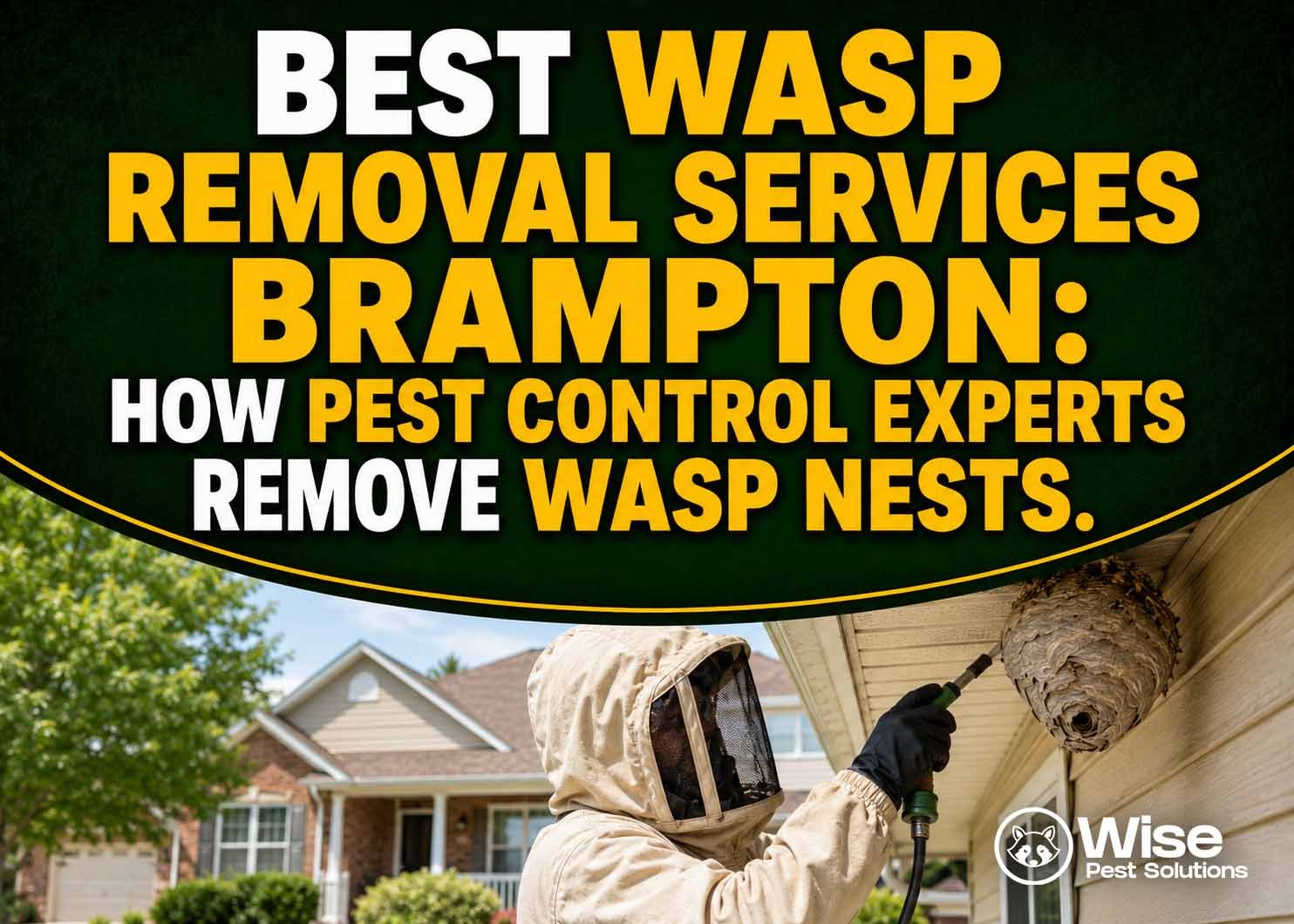
Wasps flying around a garden do not always mean there is a nest on the property. The warning sign is repeated movement toward one specific place. You may see wasps entering a soffit gap, disappearing under a deck, gathering around a shed, or flying into a hole in the lawn.
Once a nest becomes active near a doorway, patio, play area, or business entrance, avoiding it is not a practical solution. Professional wasp removal Brampton services help locate the colony, control active wasps, and address the nest without putting family members, employees, customers, or pets in unnecessary danger.
TL;DR: Professional wasp removal starts with finding the actual nest, identifying whether it is exposed or hidden, and selecting treatment based on its location. Do not spray, strike, flood, burn, or seal an active nest because disturbed wasps may defend it and hidden colonies may move further into the building.
Objective
This guide explains how professional pest control technicians locate and treat wasp nests, when removal is necessary, what the service may cost, and how to choose a suitable wasp removal company in Brampton.
Key Takeaways
- Repeated wasp movement toward one location often points to a nest.
- Wasp nests may be visible, underground, or hidden inside a wall or roofline.
- Blocking an active entry point can push wasps toward another exit.
- Professional service should include inspection, targeted treatment, and prevention guidance.
- Nest height, access, location, and colony activity affect removal costs.
- Early treatment can reduce the risk of stings and further nest growth.
Table of Contents
- Why Wasp Nests Become a Problem
- Signs You Have an Active Wasp Nest
- Where Wasps Build Nests in Brampton
- How Professional Wasp Removal Works
- DIY Versus Professional Wasp Nest Removal
- How to Choose a Wasp Exterminator in Brampton
- Wasp Nest Removal Costs and Prevention
- Frequently Asked Questions
Why Wasp Nests Become a Problem Around Brampton Properties
Wasps often become noticeable during warmer months when workers leave the nest to search for food, water, and nesting material. Activity may increase around gardens, garbage areas, outdoor dining spaces, flowering plants, and sweet drinks.
The insects usually become a safety concern when their nest is close to regular human activity.
A nest under a second-storey soffit may not cause an immediate problem. A nest beside the front door is different. Every delivery, visitor, or family member passes through the wasps’ flight path.
The same issue occurs around:
- Backyard decks and patios
- Children’s play equipment
- Garden sheds
- Garage doors
- Swimming pools
- Barbecue areas
- Commercial entrances
- Restaurant patios
- Garbage storage areas
- Loading and receiving zones
Wasps may respond defensively when a person gets too close to their nest. Lawn mowers, hedge trimmers, construction work, vibrations, sudden movement, and attempts to spray the nest can increase their activity.
Some people also experience serious allergic reactions after a sting. Health Canada advises seeking medical attention immediately if the effects of a sting are severe.
Signs You Need Wasp Removal Brampton Services
Finding one wasp indoors does not prove that a colony is living in the building. Several signs together provide a clearer picture.
Repeated Flight to One Opening
Watch the property from a safe distance. If wasps repeatedly enter the same soffit gap, wall opening, vent, bush, roof edge, or ground hole, there may be a nest behind it.
Do not stand directly in the flight path. Wasps returning to the nest may react when their route is blocked.
A Grey Paper-Like Structure
Many exposed nests look like folded grey paper. Early nests may be small and open underneath. Larger enclosed nests may appear round or oval with a visible entrance.
Do not judge the risk by size alone. Even a small active nest may be defended.
Buzzing Inside a Wall or Ceiling
A steady buzzing sound from one area may indicate a hidden nest. You may hear it near a window, roof edge, ceiling, attic corner, or exterior wall.
Wasps may also begin appearing inside the home if the colony is close to an interior space.
Increased Activity Near Garbage or Food
Wasps gathering near open bins, fallen fruit, pet food, barbecue residue, or outdoor drinks may be feeding rather than nesting. However, consistent travel between the food source and one part of the property may help reveal the nest location.
Defensive Behaviour in One Area
Wasps circling people, flying toward faces, or following someone away from one specific location may be protecting a nearby nest.
Keep children and pets out of the area until it has been inspected.
Where Wasps Commonly Build Nests in Brampton
Wasps select locations that provide protection from rain, wind, animals, and frequent disturbance. Homes with small exterior gaps may also give them access to sheltered wall or roof spaces.
Common nesting areas include:
- Roof edges and eaves
- Soffits and fascia gaps
- Exterior wall openings
- Window and door frames
- Decks and porches
- Sheds and detached garages
- Trees, hedges, and shrubs
- Fence posts
- Outdoor furniture
- Play structures
- Attics and wall voids
- Lawn and garden holes
Sheds are a common problem because they may remain closed for several days. A homeowner opens the door, begins moving tools, and suddenly finds several active wasps inside.
Deck nests create a different risk. The colony may be directly below an outdoor table or beside the stairs. People can pass within a few feet of the nest without seeing it.
Wise Pest Solutions provides wasp removal services for nests around Brampton homes, rental properties, restaurants, warehouses, offices, yards, sheds, decks, rooflines, and commercial spaces.
How Professional Wasp Nest Removal Brampton Services Work
Reliable removal is not based on spraying every wasp in sight. The technician needs to find where the insects are living and understand how they are reaching the nest.
1. Inspecting the Active Area
The inspection begins where wasps have been seen most often. The technician watches their flight pattern and checks nearby structures for openings, nest material, or concentrated activity.
The inspection may cover:
- Rooflines
- Soffits
- Wall gaps
- Decks
- Garages
- Sheds
- Trees and shrubs
- Ground openings
- Exterior vents
- Garbage areas
The goal is to distinguish a nesting site from a temporary feeding area.
2. Identifying the Nest Type and Location
The technician determines whether the nest is:
- Open and visible
- Enclosed inside a structure
- Located underground
- Built above normal reach
- Attached to a tree or shrub
- Accessible through a narrow opening
- Close to an occupied indoor space
This step matters because each location requires a different treatment plan.
An exposed nest below a porch roof can often be approached directly. A hidden colony behind brickwork cannot.
3. Planning the Treatment Area
Before treatment starts, the technician should explain where people and pets need to stay. Access to the affected yard, room, entrance, or business area may need to be limited temporarily.
Commercial properties may also need to redirect customers, staff, or deliveries until the active area is safe.
4. Applying Targeted Treatment
Treatment is directed at the nest or its access route. The method depends on nest position, activity level, surrounding materials, and access conditions.
A professional wasp removal Brampton service should focus on the colony rather than spraying unrelated sections of the property.
Products must be used according to their approved labels and safety instructions. Health Canada regulates pest control products in Canada and requires registered products to meet standards for human health, environmental protection, and value when used as directed.
5. Allowing Activity to Stop
Wasps that were away from the nest may return after treatment. Some activity around the entry point may continue for a period.
Do not immediately seal the opening unless the technician confirms that the colony is no longer active. Closing it too early may force surviving wasps to search for another route.
6. Removing the Nest When Appropriate
An exposed nest may be removed after activity has stopped. A hidden nest inside a closed wall or roof space may not need structural removal if the colony has been controlled and no activity remains.
Opening a wall simply to remove inactive nest material may cause unnecessary property damage. The technician should explain what is needed for the specific situation.
7. Providing Prevention Advice
The final step is reducing the conditions that made the property suitable for nesting.
Advice may include repairing damaged soffits, sealing exterior gaps, fitting vent covers, cleaning food residue, securing garbage bins, and checking sheltered structures during spring.
DIY Versus Professional Wasp Nest Removal
A can of spray may appear to be a quick solution. It is not suitable for every nest.
The main question is not whether the product can kill a wasp. The issue is whether it can reach and control the colony safely.
| DIY Attempt | Professional Service |
| Nest location may be guessed | Property and flight paths are inspected |
| Spray may only hit visible workers | Treatment focuses on the nest or access point |
| Protective equipment may be limited | Suitable equipment is used for the job |
| Hidden nests may remain active | Wall, roof, and ground nests are assessed |
| Entry points may be sealed too early | Sealing is completed at the proper stage |
| No follow-up advice is provided | Prevention steps are discussed |
| Ladder use increases fall risk | Access risks are considered before treatment |
Do not use fire, boiling water, gasoline, pressure washers, sticks, or garden tools on a wasp nest. These methods can cause injury, property damage, and rapid defensive activity.
A nest above a doorway or roof edge also creates a fall risk. Someone standing on a ladder may lose balance after being approached or stung by several wasps.
Professional help is the safer choice when the nest is hidden, elevated, underground, difficult to access, or close to an occupied area.
How to Choose a Wasp Exterminator Brampton Property Owners Can Trust
The best service provider is not always the company offering the lowest phone quote. The provider should be able to explain what is included and how the treatment will address the actual nest.
Ask Whether an Inspection Is Included
A useful quote should account for nest location, height, access, and activity. A flat estimate given without basic questions may not reflect the work required.
Confirm Experience With Hidden Nests
Ask how the technician handles wasps entering soffits, wall gaps, vents, roof spaces, and underground openings.
Hidden nests should not be treated as exposed nests.
Request Clear Safety Instructions
A dependable wasp exterminator Brampton residents hire should explain:
- Where people and pets need to stay
- How the affected area will be managed
- What activity may continue after treatment
- When an opening can be sealed
- Whether follow-up service may be needed
Check Residential and Commercial Experience
Residential treatment often focuses on family access, children, pets, gardens, and outdoor living spaces.
Commercial work may require additional planning around customers, employees, tenants, food areas, loading zones, and operating hours.
Look for Prevention Support
Removing one nest does not prevent another queen from selecting a different protected area later. The technician should point out visible gaps, food sources, waste issues, or sheltered spaces that may encourage future activity.
Wise Pest Solutions offers pest control Brampton services for homes and businesses. Its service pages describe inspection, targeted treatment, prevention advice, residential support, commercial support, and emergency pest control availability.
What Does Wasp Nest Removal Cost in Brampton?
Wasp removal companies usually need information about the nest before confirming a price. A visible nest at ground level involves different access and treatment requirements from a hidden nest near a third-storey roofline.
The price may depend on:
- Nest location
- Height above the ground
- Ease of access
- Colony activity
- Number of active nests
- Residential or commercial setting
- Need for special access equipment
- Hidden wall or roof access
- Follow-up requirements
- Urgency of the service
Ask for clear pricing before authorizing treatment. The quote should explain the service included, possible additional costs, and whether follow-up support is part of the work.
The cheapest option may cost more if it only treats visible insects and leaves the colony active.
How to Reduce Future Wasp Activity
Wasp prevention starts before a large nest develops. Regular property checks during spring and early summer can reveal small nests in accessible locations.
Take these steps:
- Keep garbage and recycling bins closed.
- Clean drink spills and barbecue grease.
- Cover food during outdoor meals.
- Remove fallen fruit from lawns and gardens.
- Avoid leaving pet food outside.
- Repair damaged window and door screens.
- Inspect soffits, fascia, vents, and siding gaps.
- Check sheds and garages before moving stored items.
- Look below decks, railings, and outdoor furniture.
- Seal suitable openings only after confirming they are inactive.
Do not assume every wasp on the property needs treatment. Wasps away from occupied areas may simply be feeding or passing through. Control becomes necessary when an active nest creates a safety risk or the insects begin entering the building.
Frequently Asked Questions
How quickly should I arrange wasp nest removal?
Call promptly when the nest is near a door, deck, playground, walkway, garage, workplace entrance, or outdoor dining area. Fast action is also sensible when someone on the property has a known sting allergy.
Can I seal the hole wasps are using?
Not while the nest is active. Wasps trapped behind the opening may search for another exit and move into the building. Treatment should be completed before permanent sealing.
Will the nest be physically removed?
Exposed nests may be removed once activity has stopped. Hidden nests do not always require physical removal. The technician should base the decision on nest access, remaining activity, and the risk of property damage.
Is professional wasp treatment safe for children and pets?
The technician should provide instructions based on the treatment area and product being used. Keep children and pets away from the active area until the provider confirms that it is safe to return.
What if the wasp nest is in a City-owned tree?
The City of Brampton states that its Pest Management Specialist responds to public concerns involving wasp and hornet nests in City trees. According to the City, a nest is destroyed only when it is on a branch no higher than five metres above the ground. Contact Brampton 311 when the affected tree is on City property.
What should I do after a serious wasp sting?
Get immediate medical care if the person develops severe swelling, breathing difficulty, dizziness, or another serious reaction. Health Canada advises seeing a doctor right away when the effects of a sting are severe.
Schedule Professional Wasp Removal in Brampton
A wasp nest near an entrance, roofline, shed, deck, garden, or commercial space should be handled before someone gets stung. Early inspection also makes it easier to identify the flight path and treat the colony before activity increases.
For wasp removal Brampton homeowners, landlords, property managers, and businesses can arrange, contact Wise Pest Solutions to request an inspection or service quote. The team handles visible and hidden nests and provides practical guidance to reduce future wasp problems.